
 Image 1 of 4
 Image 2 of 4
 Image 3 of 4
 Image 4 of 4
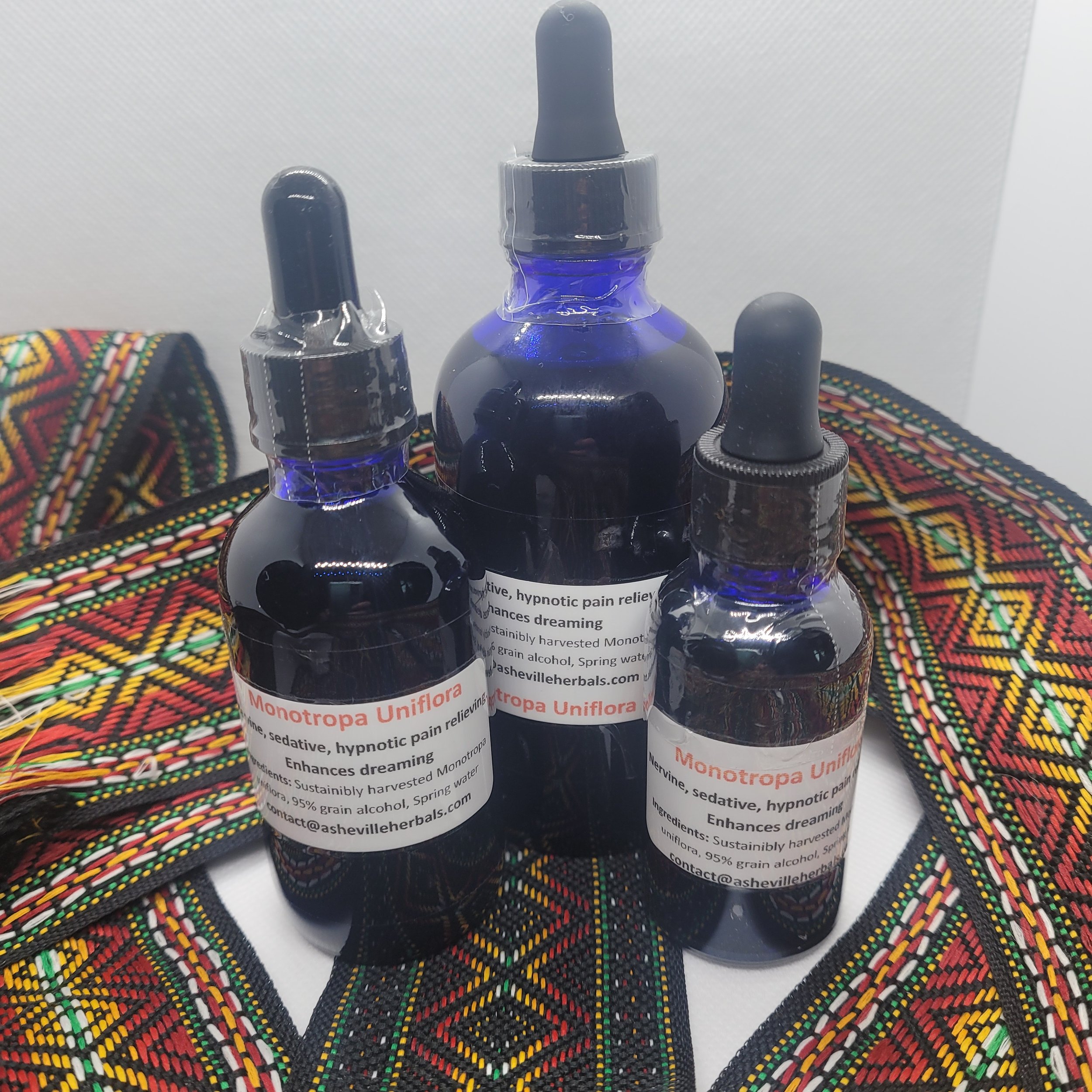
Ghost Pipe tincture
Ghost Pipe
Monotropa uniflora
A rare woodland ally for deep quiet, inner stillness, and threshold awareness
Botanical Overview
Ghost Pipe—also called Indian Pipe—is a striking, entirely chlorophyll-free woodland herb found in shaded, moist forests. Its translucent white stems and nodding flowers emerge from the forest floor like small lanterns of mist, often after summer rains.
Botanical family: Ericaceae
Parts used: Fresh aerial parts (traditionally); Asheville Herbals uses sustainably sourced plant matter only
Habitat: Mature, undisturbed forests with deep leaf litter, rich fungal networks, and high moisture
Growth habit: A mycoheterotroph—it does not photosynthesize but receives nutrients through a symbiotic relationship with mycorrhizal fungi and surrounding trees.
Ghost Pipe’s life cycle depends on intact forest ecosystems. It cannot be cultivated easily, which is why ethical approach matters profoundly.
Traditional & Cultural History
Ghost Pipe appears in many North American traditions as a plant of quieting, threshold navigation, and deep inward listening. Eastern Band Cherokee and other Indigenous nations held it as a rare woodland ally associated with:
• Calming overstimulation
• Helping the spirit “step back” from overwhelming emotional states
• Supporting ceremony, dreamwork, and periods of transition
Because of its rarity and ecological sensitivity, Ghost Pipe was never a common everyday remedy. It was used sparingly, intentionally, and often ceremonially.
European and American herbalists of the 1800s later adopted Ghost Pipe into their materia medica, describing it as a plant that helped “soften the sharp edges” of pain—physical or emotional—and deepen introspective calm. These uses were always noted as requiring respect.
Modern Understanding & Scientific Insights
Research on Monotropa uniflora is limited, but we do understand several key points:
Unique ecology
• Ghost Pipe receives its nutrition indirectly from trees via mycorrhizal fungi.
• This ecological dependency makes the plant extremely sensitive to disturbance—one reason it should never be mass-harvested.
Plant chemistry
While historic herbal literature speculated on alkaloids, modern analysis suggests the plant contains phenolic compounds, glycosides, and trace volatile constituents—but nothing comparable to psychedelic or narcotic plants.
Its effects, based on tradition and anecdotal use, appear to come more from subtle nervous-system modulation than from strong pharmacological force.
Contemporary research directions include:
• Ghost Pipe’s ecological role and fungal partnerships
• Non-psychoactive pathways that influence sensory gating and emotional processing
• Potential anti-inflammatory and antioxidant properties (early-stage, not clinically confirmed)
There are no human clinical trials, and the plant should not be treated as a conventional pain remedy. Its cultural story emphasizes inwardness, not intoxication.
How Asheville Herbals Uses This Plant
We prepare small-batch, low-impact Ghost Pipe tincture from ethically gathered plants—meaning:
• Only from populations that are abundant
• Never uprooted
• Only partial harvests from a cluster
• Never from disturbed or declining habitats
Our extraction uses fresh material and a gentle alcohol–water blend to preserve the plant’s subtle signature.
Because of its ecological sensitivity, we offer Ghost Pipe seasonally and sparingly, as a ceremonial botanical rather than a daily-use herb.
Energetic & Symbolic Qualities
Ghost Pipe is traditionally associated with:
• Deep quieting of overstimulation
• Witness-awareness—stepping back from emotional overwhelm
• A sense of “being held in stillness”
• Visionary or introspective states that arise from calm, not excitation
• Threshold experiences—grief, major life change, initiation, or times when the inner world feels loud
While strong physical effects are not part of Ghost Pipe’s profile, many people describe its presence as centering, slowing, and softening, helping them reconnect with the quiet voice beneath the noise.
Suggested Ways to Work With Ghost Pipe
No medical claims—only gentle ritual suggestions:
• During meditation on difficult emotions
• In grief rituals or times of emotional processing
• Before dreamwork, journaling, or ceremonial introspection
• As part of a grounding ritual after intense personal work
• In a quiet environment where subtle shifts can be felt
Ghost Pipe is best approached like a rare teacher—slowly, with clear intention and respect for its ecological role.
Contraindications & Safety Notes
Because research is limited and the plant is potent in subtle ways, please keep the following in mind:
• Not for pregnancy, breastfeeding, or children.
• Avoid combining with alcohol, sedatives, or psychoactive substances.
• May deepen quietude or emotional introspection—avoid use when alertness is required.
• Individuals with major psychiatric conditions should consult a healthcare provider before working with any introspective botanical.
• Must only be purchased from ethical, small-scale herbalists.
• Never forage Ghost Pipe without training; irresponsible harvesting can destroy entire colonies.
Ghost Pipe is not a painkiller, a recreational substance, or a plant for frequent use.
It is a ceremonial ally.
Our Ghost Pipe Tincture is produced in extremely limited quantities.
Each batch comes from sensitive, ethical harvest practices and reflects the plant’s true nature: quiet, introspective, and deeply tied to healthy forest ecosystems.
We view Ghost Pipe as a companion for inner work—not a remedy to chase intensity.
FDA Disclaimer
These statements have not been evaluated by the FDA. This product is not intended to diagnose, treat, cure, or prevent any disease.
Ghost Pipe
Monotropa uniflora
A rare woodland ally for deep quiet, inner stillness, and threshold awareness
Botanical Overview
Ghost Pipe—also called Indian Pipe—is a striking, entirely chlorophyll-free woodland herb found in shaded, moist forests. Its translucent white stems and nodding flowers emerge from the forest floor like small lanterns of mist, often after summer rains.
Botanical family: Ericaceae
Parts used: Fresh aerial parts (traditionally); Asheville Herbals uses sustainably sourced plant matter only
Habitat: Mature, undisturbed forests with deep leaf litter, rich fungal networks, and high moisture
Growth habit: A mycoheterotroph—it does not photosynthesize but receives nutrients through a symbiotic relationship with mycorrhizal fungi and surrounding trees.
Ghost Pipe’s life cycle depends on intact forest ecosystems. It cannot be cultivated easily, which is why ethical approach matters profoundly.
Traditional & Cultural History
Ghost Pipe appears in many North American traditions as a plant of quieting, threshold navigation, and deep inward listening. Eastern Band Cherokee and other Indigenous nations held it as a rare woodland ally associated with:
• Calming overstimulation
• Helping the spirit “step back” from overwhelming emotional states
• Supporting ceremony, dreamwork, and periods of transition
Because of its rarity and ecological sensitivity, Ghost Pipe was never a common everyday remedy. It was used sparingly, intentionally, and often ceremonially.
European and American herbalists of the 1800s later adopted Ghost Pipe into their materia medica, describing it as a plant that helped “soften the sharp edges” of pain—physical or emotional—and deepen introspective calm. These uses were always noted as requiring respect.
Modern Understanding & Scientific Insights
Research on Monotropa uniflora is limited, but we do understand several key points:
Unique ecology
• Ghost Pipe receives its nutrition indirectly from trees via mycorrhizal fungi.
• This ecological dependency makes the plant extremely sensitive to disturbance—one reason it should never be mass-harvested.
Plant chemistry
While historic herbal literature speculated on alkaloids, modern analysis suggests the plant contains phenolic compounds, glycosides, and trace volatile constituents—but nothing comparable to psychedelic or narcotic plants.
Its effects, based on tradition and anecdotal use, appear to come more from subtle nervous-system modulation than from strong pharmacological force.
Contemporary research directions include:
• Ghost Pipe’s ecological role and fungal partnerships
• Non-psychoactive pathways that influence sensory gating and emotional processing
• Potential anti-inflammatory and antioxidant properties (early-stage, not clinically confirmed)
There are no human clinical trials, and the plant should not be treated as a conventional pain remedy. Its cultural story emphasizes inwardness, not intoxication.
How Asheville Herbals Uses This Plant
We prepare small-batch, low-impact Ghost Pipe tincture from ethically gathered plants—meaning:
• Only from populations that are abundant
• Never uprooted
• Only partial harvests from a cluster
• Never from disturbed or declining habitats
Our extraction uses fresh material and a gentle alcohol–water blend to preserve the plant’s subtle signature.
Because of its ecological sensitivity, we offer Ghost Pipe seasonally and sparingly, as a ceremonial botanical rather than a daily-use herb.
Energetic & Symbolic Qualities
Ghost Pipe is traditionally associated with:
• Deep quieting of overstimulation
• Witness-awareness—stepping back from emotional overwhelm
• A sense of “being held in stillness”
• Visionary or introspective states that arise from calm, not excitation
• Threshold experiences—grief, major life change, initiation, or times when the inner world feels loud
While strong physical effects are not part of Ghost Pipe’s profile, many people describe its presence as centering, slowing, and softening, helping them reconnect with the quiet voice beneath the noise.
Suggested Ways to Work With Ghost Pipe
No medical claims—only gentle ritual suggestions:
• During meditation on difficult emotions
• In grief rituals or times of emotional processing
• Before dreamwork, journaling, or ceremonial introspection
• As part of a grounding ritual after intense personal work
• In a quiet environment where subtle shifts can be felt
Ghost Pipe is best approached like a rare teacher—slowly, with clear intention and respect for its ecological role.
Contraindications & Safety Notes
Because research is limited and the plant is potent in subtle ways, please keep the following in mind:
• Not for pregnancy, breastfeeding, or children.
• Avoid combining with alcohol, sedatives, or psychoactive substances.
• May deepen quietude or emotional introspection—avoid use when alertness is required.
• Individuals with major psychiatric conditions should consult a healthcare provider before working with any introspective botanical.
• Must only be purchased from ethical, small-scale herbalists.
• Never forage Ghost Pipe without training; irresponsible harvesting can destroy entire colonies.
Ghost Pipe is not a painkiller, a recreational substance, or a plant for frequent use.
It is a ceremonial ally.
Our Ghost Pipe Tincture is produced in extremely limited quantities.
Each batch comes from sensitive, ethical harvest practices and reflects the plant’s true nature: quiet, introspective, and deeply tied to healthy forest ecosystems.
We view Ghost Pipe as a companion for inner work—not a remedy to chase intensity.
FDA Disclaimer
These statements have not been evaluated by the FDA. This product is not intended to diagnose, treat, cure, or prevent any disease.