 Image 1 of 2
 Image 2 of 2
Fly Agaric
A folkloric teacher of thresholds, transformation, and altered perception
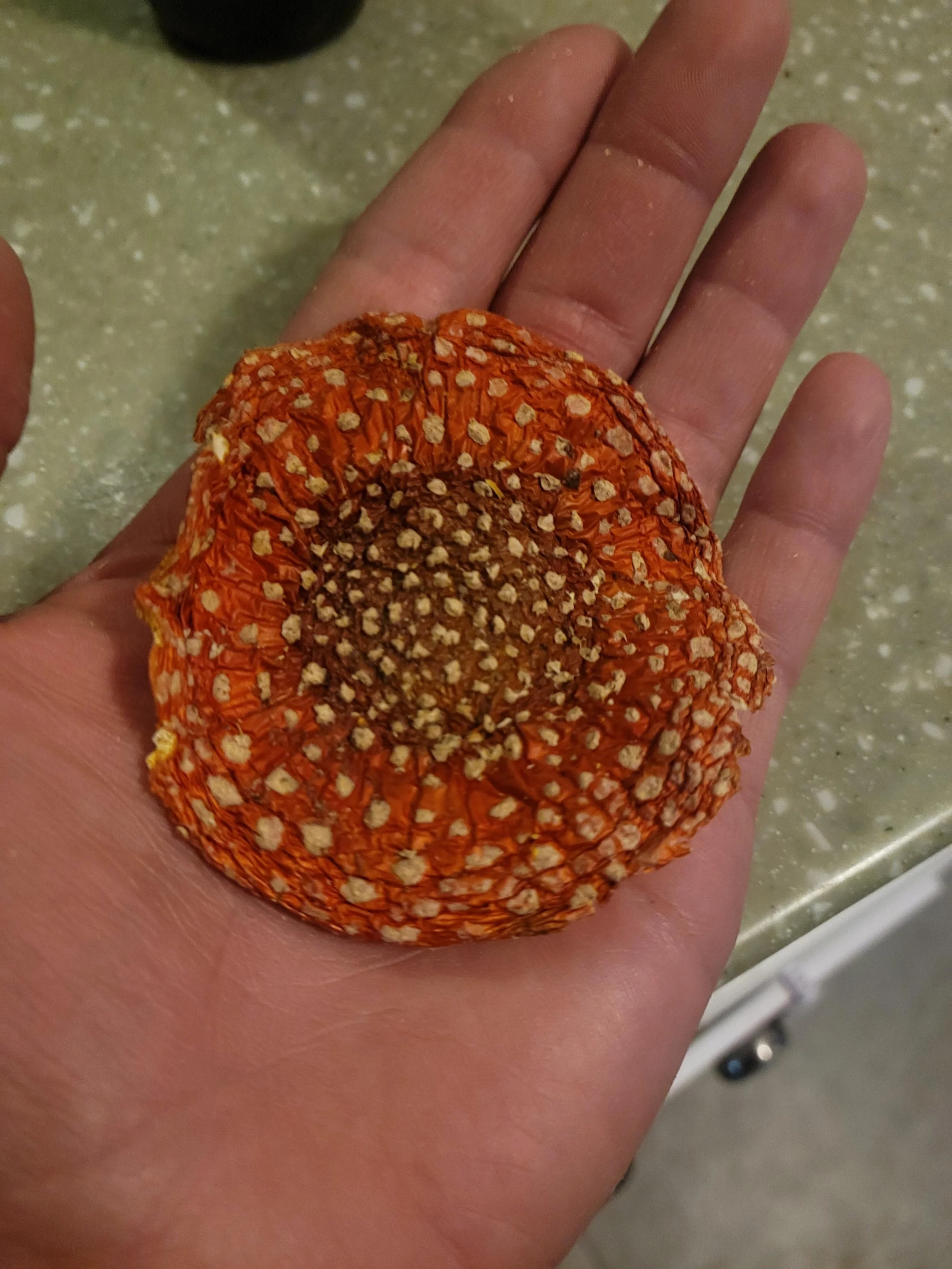
Amanita muscaria is one of the world’s most recognizable mushrooms—its bright red cap speckled with white spots has appeared in European folk art, Siberian myth, and modern symbolism for centuries.
Botanical family: Amanitaceae
Parts used: Cap (traditionally dried), occasionally the whole mushroom in historical contexts
Habitat: Spruce, pine, birch, and fir forests across the Northern Hemisphere
Growth habit: Mycorrhizal mushroom forming symbiotic partnerships with trees; fruits in late summer through fall
The mushroom’s striking appearance and long cultural history have made it a central figure in mythic storytelling and shamanic ritual across Eurasia.
Amanita muscaria holds a unique place in the ethnobotanical record. In parts of Siberia and Northern Europe, it has been used ceremonially for thousands of years. Within these traditions, the mushroom served as a visionary ally, helping mediators, healers, and shamans cross into altered states for divination, healing, and communication with the unseen.
Across Europe, the mushroom became a symbol of luck, winter renewal, and threshold magic, appearing in solstice rituals, folklore, and holiday iconography. In Norse and Saami traditions, tales describe the mushroom as an intermediary between worlds—fiery, primordial, and transformative.
It is important to note that these uses were highly skilled, carefully contextual, and culturally specific. Misuse or misidentification has historically caused harm, which is why traditional practitioners used well-defined preparation methods and ceremonial frameworks.
Amanita muscaria contains several naturally occurring compounds that have drawn interest from researchers exploring the mushroom’s neurological and metabolic effects. These constituents behave very differently from psilocybin and should not be confused with psychedelic mushrooms.
Key constituents include:
• Ibotenic acid – an excitatory compound that naturally decarboxylates into muscimol when dried or heated
• Muscimol – a GABA-receptor–active compound associated with relaxation, altered perception, and dreamlike states
• Muscarine – present only in trace amounts in A. muscaria, contrary to popular belief
Modern research is still in early stages, but current areas of exploration include:
• How muscimol interacts with GABAergic pathways
• The mushroom’s effect on sleep cycles, sensorimotor patterns, and deep relaxation
• The role careful decarboxylation plays in shifting ibotenic acid toward muscimol
Because human clinical trials are limited, all insights remain preliminary. Nonetheless, proper preparation—especially thorough decarboxylation—plays a central role in shaping the mushroom’s experience, safety, and traditional use.
Our Amanita muscaria tincture is crafted with a thorough decarboxylation process, followed by a slow extraction designed to balance the mushroom’s chemistry gently and predictably.
This preparation honors both the folklore surrounding Amanita muscaria and the modern understanding of its active constituents.
We do not produce or endorse products intended for intoxication. Instead, our focus is on providing a respectful, carefully handled extract that reflects the mushroom’s traditional use as a grounding, dream-supportive, and introspective botanical.
Across cultures, Amanita muscaria is seen as a threshold ally—a being that teaches about boundaries, transitions, and the movement between ordinary and non-ordinary perception.
Energetic themes often associated with this mushroom include:
• Rootedness during personal transformation
• Dream depth and symbolic awareness
• Repatterning old emotional or behavioral loops
• Engaging the subconscious with structure and discipline
• A fiery, volcanic quality softened by deep earth grounding
Many customers who work with Amanita in a respectful, intentional way describe it as a plant (or rather, fungal) ally that encourages slow recalibration, pattern recognition, and an unusual clarity within the liminal spaces of the mind.
No medical or experiential claims are made here—only general suggestions for safe, grounded personal ritual:
• As part of an evening grounding practice
• Before journaling or dream incubation work
• In quiet, reflective settings where emotional or spiritual processing is welcome
• With intention-setting prior to sleep
• Paired with breathing exercises, meditation, or somatic awareness practices
Amanita muscaria is not a recreational mushroom. It is best approached with respect, patience, and a clear environment.
Amanita muscaria has a complex chemistry and must be approached responsibly.
Please keep the following in mind:
• Do not combine with alcohol, sedatives, or medications that affect the GABA system.
• Avoid if pregnant, breastfeeding, or under 18.
• Not recommended for individuals with seizure disorders, bipolar disorder, psychotic-spectrum conditions, or major neurological illness.
• Only use well-prepared, properly decarboxylated extracts—raw or improperly prepared Amanita can cause nausea, confusion, or unpleasant overstimulation.
• Never forage Amanita unless you are an expert; misidentification can be dangerous.
• Do not drive or operate machinery after use.
• Effects can vary significantly between individuals; start with respect, clear intention, and environmental safety.
Our Amanita muscaria Decarboxylated Extract is crafted with precision, patience, and a commitment to safety.
Each batch is heat-treated to convert ibotenic acid into muscimol and extracted slowly to yield a clear, smooth, intentionally balanced preparation suitable for quiet ritual, dreamwork support, and grounding practices.
These statements have not been evaluated by the FDA. This product is not intended to diagnose, treat, cure, or prevent any disease.
Fly Agaric
A folkloric teacher of thresholds, transformation, and altered perception
Amanita muscaria is one of the world’s most recognizable mushrooms—its bright red cap speckled with white spots has appeared in European folk art, Siberian myth, and modern symbolism for centuries.
Botanical family: Amanitaceae
Parts used: Cap (traditionally dried), occasionally the whole mushroom in historical contexts
Habitat: Spruce, pine, birch, and fir forests across the Northern Hemisphere
Growth habit: Mycorrhizal mushroom forming symbiotic partnerships with trees; fruits in late summer through fall
The mushroom’s striking appearance and long cultural history have made it a central figure in mythic storytelling and shamanic ritual across Eurasia.
Amanita muscaria holds a unique place in the ethnobotanical record. In parts of Siberia and Northern Europe, it has been used ceremonially for thousands of years. Within these traditions, the mushroom served as a visionary ally, helping mediators, healers, and shamans cross into altered states for divination, healing, and communication with the unseen.
Across Europe, the mushroom became a symbol of luck, winter renewal, and threshold magic, appearing in solstice rituals, folklore, and holiday iconography. In Norse and Saami traditions, tales describe the mushroom as an intermediary between worlds—fiery, primordial, and transformative.
It is important to note that these uses were highly skilled, carefully contextual, and culturally specific. Misuse or misidentification has historically caused harm, which is why traditional practitioners used well-defined preparation methods and ceremonial frameworks.
Amanita muscaria contains several naturally occurring compounds that have drawn interest from researchers exploring the mushroom’s neurological and metabolic effects. These constituents behave very differently from psilocybin and should not be confused with psychedelic mushrooms.
Key constituents include:
• Ibotenic acid – an excitatory compound that naturally decarboxylates into muscimol when dried or heated
• Muscimol – a GABA-receptor–active compound associated with relaxation, altered perception, and dreamlike states
• Muscarine – present only in trace amounts in A. muscaria, contrary to popular belief
Modern research is still in early stages, but current areas of exploration include:
• How muscimol interacts with GABAergic pathways
• The mushroom’s effect on sleep cycles, sensorimotor patterns, and deep relaxation
• The role careful decarboxylation plays in shifting ibotenic acid toward muscimol
Because human clinical trials are limited, all insights remain preliminary. Nonetheless, proper preparation—especially thorough decarboxylation—plays a central role in shaping the mushroom’s experience, safety, and traditional use.
Our Amanita muscaria tincture is crafted with a thorough decarboxylation process, followed by a slow extraction designed to balance the mushroom’s chemistry gently and predictably.
This preparation honors both the folklore surrounding Amanita muscaria and the modern understanding of its active constituents.
We do not produce or endorse products intended for intoxication. Instead, our focus is on providing a respectful, carefully handled extract that reflects the mushroom’s traditional use as a grounding, dream-supportive, and introspective botanical.
Across cultures, Amanita muscaria is seen as a threshold ally—a being that teaches about boundaries, transitions, and the movement between ordinary and non-ordinary perception.
Energetic themes often associated with this mushroom include:
• Rootedness during personal transformation
• Dream depth and symbolic awareness
• Repatterning old emotional or behavioral loops
• Engaging the subconscious with structure and discipline
• A fiery, volcanic quality softened by deep earth grounding
Many customers who work with Amanita in a respectful, intentional way describe it as a plant (or rather, fungal) ally that encourages slow recalibration, pattern recognition, and an unusual clarity within the liminal spaces of the mind.
No medical or experiential claims are made here—only general suggestions for safe, grounded personal ritual:
• As part of an evening grounding practice
• Before journaling or dream incubation work
• In quiet, reflective settings where emotional or spiritual processing is welcome
• With intention-setting prior to sleep
• Paired with breathing exercises, meditation, or somatic awareness practices
Amanita muscaria is not a recreational mushroom. It is best approached with respect, patience, and a clear environment.
Amanita muscaria has a complex chemistry and must be approached responsibly.
Please keep the following in mind:
• Do not combine with alcohol, sedatives, or medications that affect the GABA system.
• Avoid if pregnant, breastfeeding, or under 18.
• Not recommended for individuals with seizure disorders, bipolar disorder, psychotic-spectrum conditions, or major neurological illness.
• Only use well-prepared, properly decarboxylated extracts—raw or improperly prepared Amanita can cause nausea, confusion, or unpleasant overstimulation.
• Never forage Amanita unless you are an expert; misidentification can be dangerous.
• Do not drive or operate machinery after use.
• Effects can vary significantly between individuals; start with respect, clear intention, and environmental safety.
Our Amanita muscaria Decarboxylated Extract is crafted with precision, patience, and a commitment to safety.
Each batch is heat-treated to convert ibotenic acid into muscimol and extracted slowly to yield a clear, smooth, intentionally balanced preparation suitable for quiet ritual, dreamwork support, and grounding practices.
These statements have not been evaluated by the FDA. This product is not intended to diagnose, treat, cure, or prevent any disease.